We’re celebrating Hispanic Heritage Month with the beauty of bilingual poetry. While translated works are powerful, there’s something especially magical about poems that move between Spanish and English with such ease, weaving both languages into one voice.
Each line carries rhythm and intention. Every word is chosen carefully, but writing in two languages is more than a stylistic choice. It’s a reflection of culture, a way of honoring history, and a testament to the present. For bilingual poets, writing in both Spanish and English feels as natural as breathing, allowing them to fully express the layers of their identity.
Here are a handful of bilingual poetry collections to add to your shelves, along with stunning poems blending English and Spanish telling stories, painting images, and speaking truths only the poet can share.
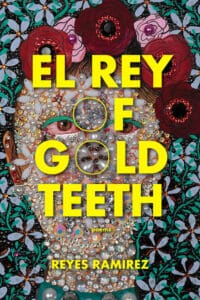
Through the voices of an astronaut, a tennis player, a drag queen, family members, an alternate version of the self, and even a turtle, these propulsive poems embody the many marginalized voices demanding to be remembered in a nation that requires erasure of histories.
Colonizing languages and subverting forms, rerouting histories, and finding the mundane made extraordinary, El Rey of Gold Teeth breaks open notions of destiny, in humorous and devastating ways, to reimagine the past and present a new future where lack transforms to abundance, where there will be many answers to every question. Reyes Ramirez’s debut poetry collection plays in spaces of both elegy and joy, and introduces a vibrant new talent.
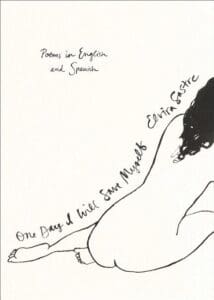
Counting the days that pass after a devastating breakup, Elvira Sastre confronts the haunting questions that surround every failed relationship: What happened? Where did it all go wrong? How did it all fall apart?
With a bold, lyrical voice poised on the knife’s edge of romance and grief, Sastre evokes the heady rush of first love and the sorrow of its painful end–even as she learns to pick up the pieces and move on after the worst has happened.
At once deeply personal and universally resonant, painful and resoundingly hopeful, One Day I Will Save Myself speaks to the poet in all of us. An intimate journey through loving, losing, and living that inspires readers to begin their own healing and is perfect for fans of Rupi Kaur, r.h. Sin, and Atticus.
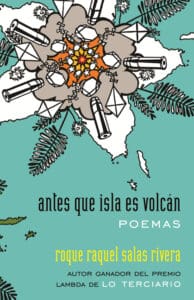
Raquel Salas Rivera’s star has risen swiftly in the poetry world, and this, his 6th book, promises to cement his status as one of the most important poets working today. In sharp, crystalline verses, written in both Spanish and English versions, antes que isla es volcán daringly imagines a decolonial Puerto Rico.
Salas Rivera unfurls series after series of poems that build in intensity: one that casts Puerto Rico as the island of Caliban in Shakespeare’s The Tempest, another that imagines a multiverse of possibilities for Puerto Rico’s fate, a 3rd in which the poet demands his right to a future and its immediate distribution. The verses are rigorous and sophisticated, engaging with literary and political theory, yet are also hard-hitting, charismatic, and quotable (“won’t you be sorry? / won’t you wish you had a boss? / won’t you get restless / with all that freedom?”).
These poems tap unflinchingly into the explosive energy of the island, transforming it into protest, into spirit, into art.
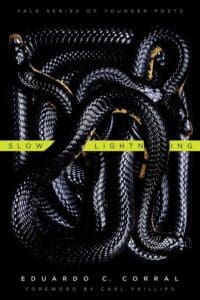
Eduardo C. Corral is the 2011 recipient of the Yale Series of Younger Poets award, joining such distinguished previous winners as Adrienne Rich, W. S. Merwin, and John Ashbery. The first Latino poet to win the competition, Corral is also winner of the 2011 Whiting Writers Award.
Seamlessly braiding English and Spanish, Corral’s poems hurtle across literary and linguistic borders toward a lyricism that slows down experience. He employs a range of forms and phrasing, bringing the vivid particulars of his experiences as a Chicano and gay man to the page. Although Corral’s topics are decidedly sobering, contest judge Carl Phillips observes, “one of the more surprising possibilities offered in these poems is joy.”
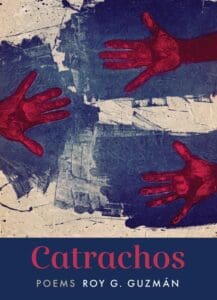
A name for the people of Honduras, Catrachos is a term of solidarity and resilience. In these unflinching, riveting poems, Roy G. Guzmán reaches across borders–between life and death and between countries–invoking the voices of the lost.
Part immigration narrative, part elegy, and part queer coming-of-age story, Catrachos finds its own religion in fantastic figures such as the X-Men, pop singers, and the “Queerodactyl,” which is imagined in a series of poems as a dinosaur sashaying in the shadow of an oncoming comet, insistent on surviving extinction. With exceptional energy, humor, and inventiveness, Guzmán’s debut is a devastating display of lyrical and moral complexity–an introduction to an immediately captivating, urgently needed voice.